This piece was originally published on my digital art blog, and discusses the work of Scottish artist Rachel MacLean
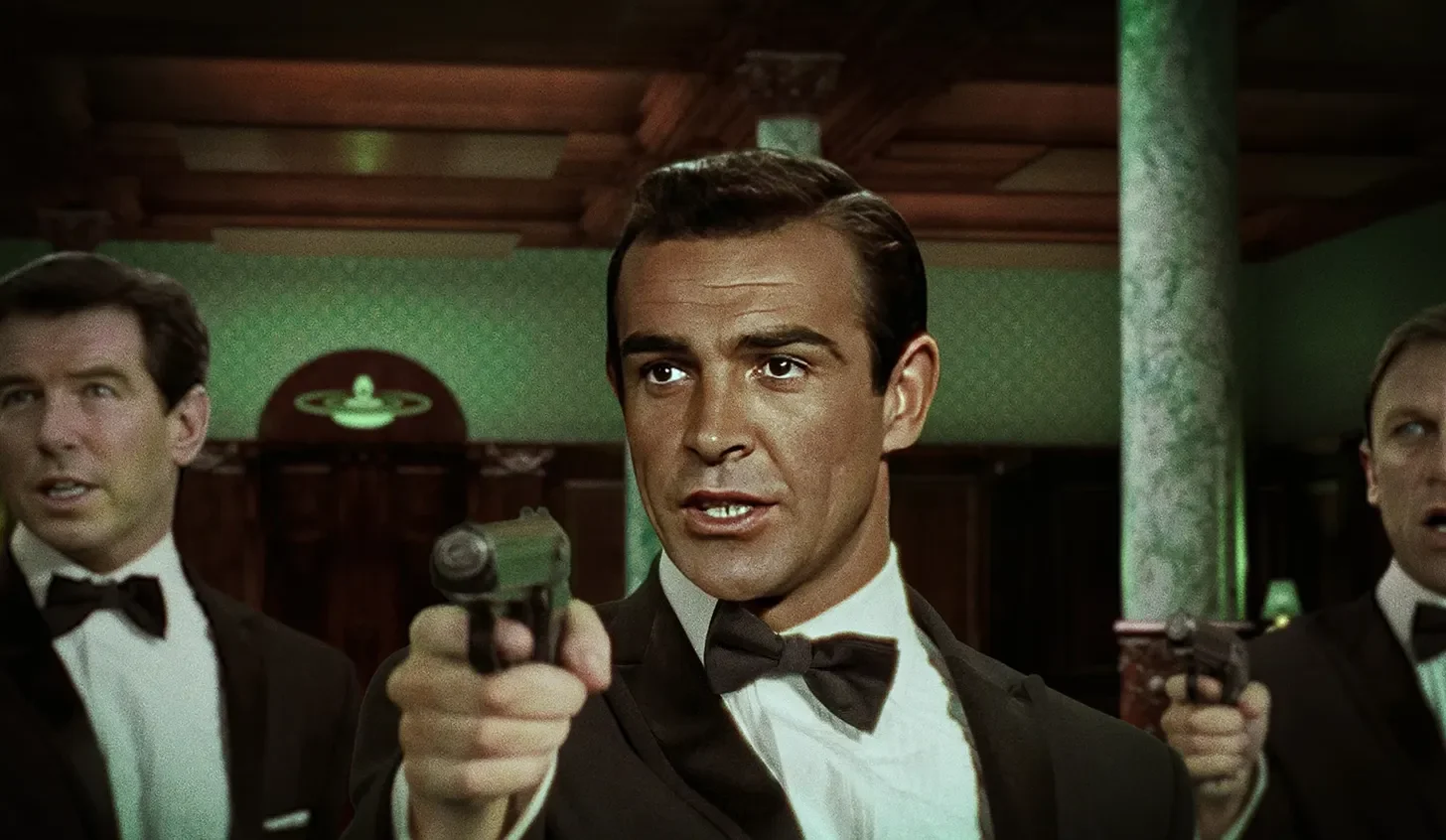
DUCK is an eerie walk through the uncanny valley of deepfakes, a dark and absurd exploration of truth and power that is both enticing and unnerving to watch.
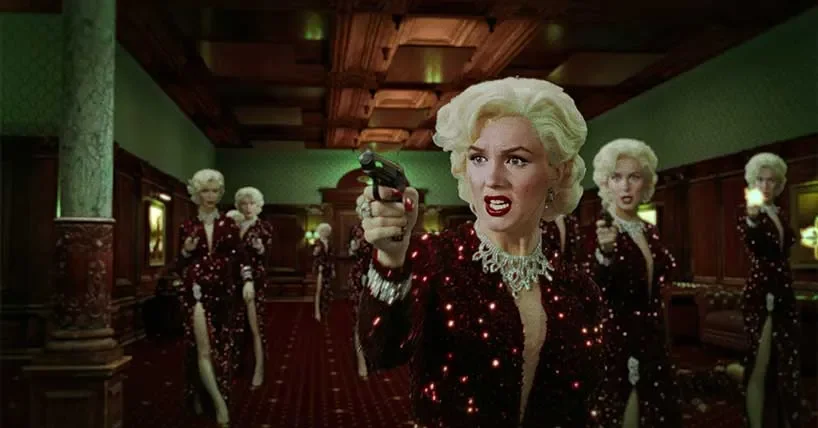
The 16 minute film tracks the labyrinthine journey of one Sean-Connery-as-James-Bond as he attempts to unravel the mystery surrounding Marilyn Monroe’s return from the grave.
Set in a world of dark mahogany, brooding lighting, and perpetual dusk, DUCK is in some ways wildly different from most of MacLean’s work to date. Maclean is a Scottish multimedia artist, probably best known for her techni-colour film creations. Her distinctive film works use elaborate and meticulously crafted costuming, props and makeup, alongside high level animation to create surreal worlds and characters.
Many of her video pieces take place in a hyper stylised, bizarre fantasy world which draws on the rich mythologies of fairy tales, nationalism, and digitality. MacLean plays all of her characters herself, decked out to the nines in custom made costumes and prosthetics. She acts out the various parts in front of a green screen, and animates the surreal surroundings later.
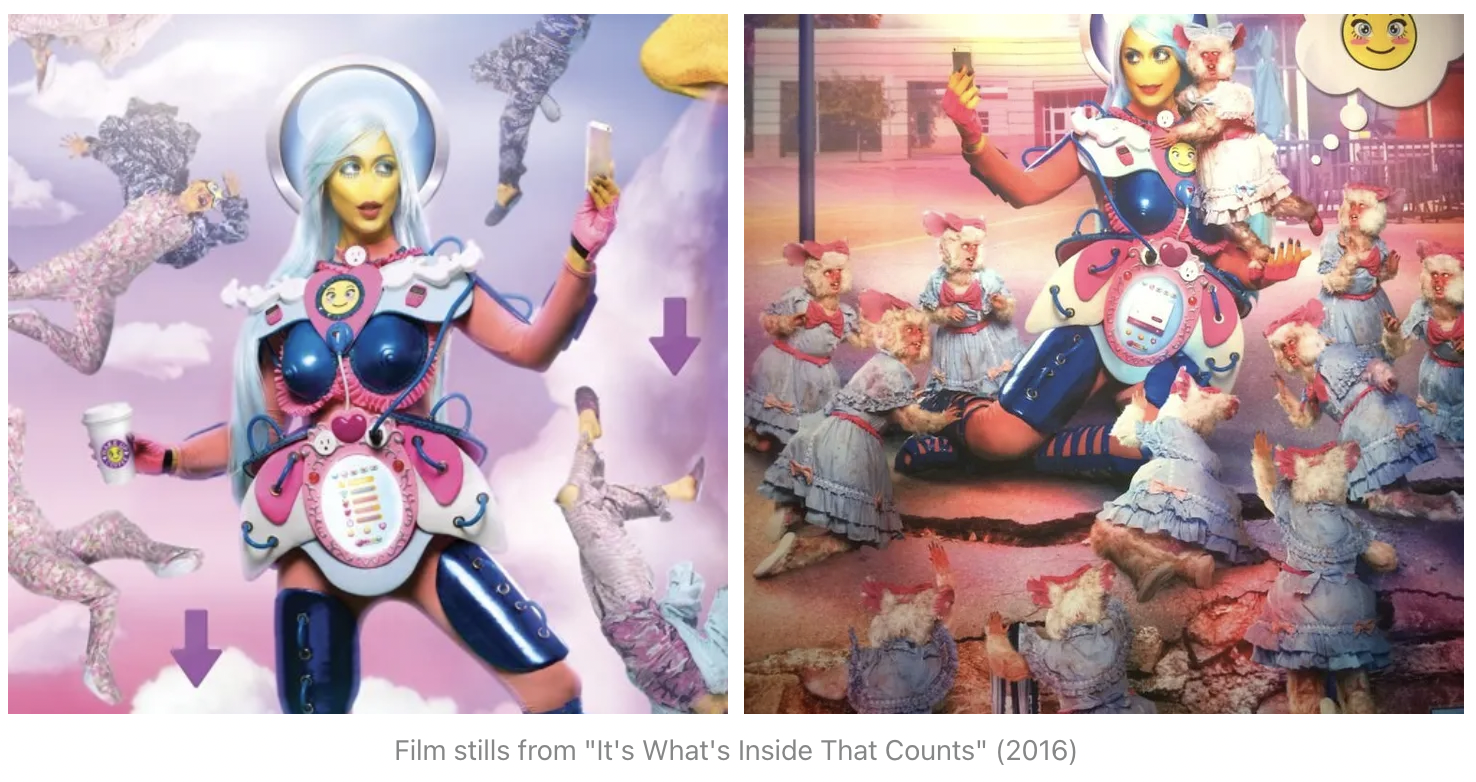
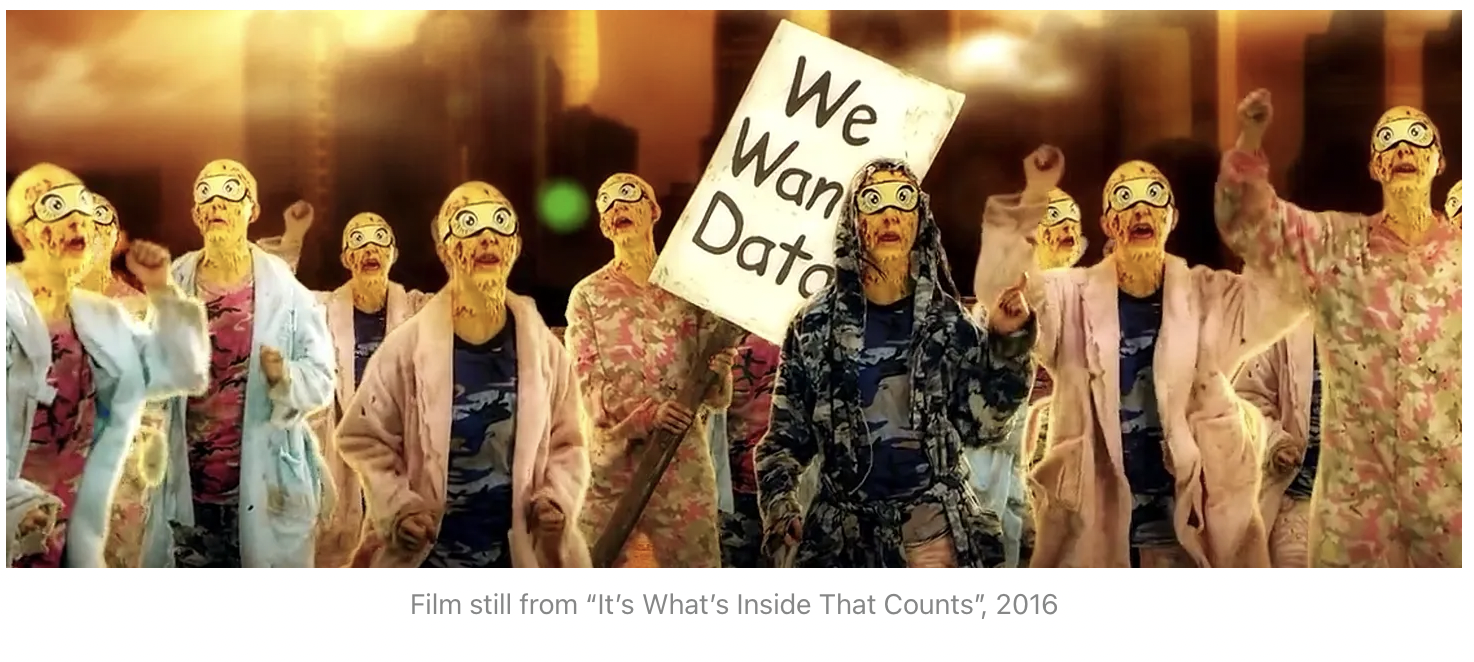
In It’s What’s Inside That Counts MacLean immerses us in a parody of online life, set in “a dystopian metropolis fuelled by fevered connectivity” in which “a race of rodents beneath the decaying streets hack the sales messages of a Kardashian-type Demigod, more cyborg than human”. Influencers float in the sky doling out mindfulness advice in sickeningly soothing cadences, while hordes of pyjama-d and sleep-masked individuals gather below screaming “WE WANT DATA!”. The dissonance is jarring.
DUCK is indeed a good deal different stylistically, but it’s thematic concerns are not a million miles away. MacLean’s practice has always been concerned with power - the power of the individual, the system, the power of representation, the power dynamics of gender. DUCK shares these concerns, and explores the tensions of living in a world where “truth” and “reality” have become mere concepts, as debatable and personal as one’s taste in music.
The deepfake technology is impressive - it really does look like Connery, Brosnan, and Monroe…but it’s also clearly artifice. The faces have a strange, luminous quality. The movements are stylised. The environments are blurred and glowing. It is impossible to escape the illusory nature of each scene. Of course, none of this is accidental. As MacLean says herself “DUCK is a film that uses deepfake, but it’s also a film about deepfake”, so there’s no need to hide her tools.
MacLean is acutely aware of how representation of womens in media often uphold and perpetuate their position within society. We all know how it goes by now - hyper sexualized images of women in advertising, TV, and film. Seemingly arbitrary censorship of women’s bodies on social media. Excessive violence towards women acted out or dissected across all media channels. The female body as fodder is nothing new. Of course, Deepfake technology raises real concerns over the (further) manipulation and abuse of women's images in media - it is disturbingly easy now to create fabricated pornographic images of women, and spread them widely.
The film also goes to great lengths to subvert the typical power dynamics that we might expect from a Bond film, or from a piece of deepfake footage. The central character, Connery-Bond, is not your typical symbol of male sovereignty and power. He is massively destabilised, fumbling through a world where nothing makes sense. All the other characters seem to understand the rules of this deepfake world - they know that nothing is real, they know that images can be artifice. But Connery is painfully naive.
Holding up a photograph in which Marilyn peels back her human face to reveal a giant duck bill, Connery asks “This photo…who took it?”, to which Roger Moore replies: “My dear boy, nobody took it”
Connery: “What do you mean?”
Moore: “Ever heard of photoshop?”
Connery: “No!” (cue mocking laughter from all the other Bonds)
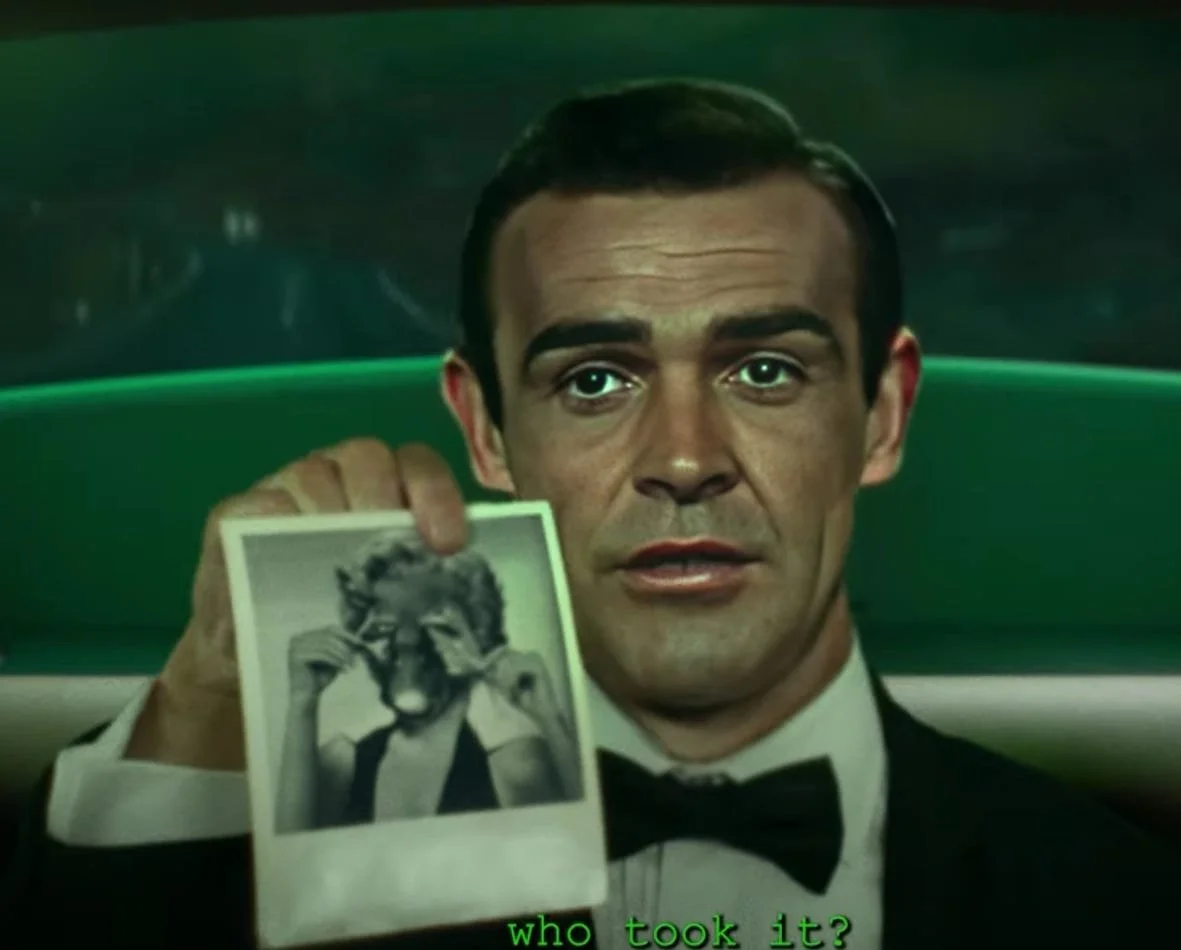
Connery doesn’t even understand what he’s up against, the level of un-reality he’s dealing with. The character is superbly acted by MacLean, who plays him as an awkward, uncertain man, his face flinching in shock, his eyes cast downward in confusion - it’s Bond as we’ve never seen him before - fallible, fumbling, afloat.
Monroe, on the other hand, is fully clued-in to the rules of this world, and understands herself for what she is - a representation. She knows she is a deepfake, and she understands the power of being “just” an image, and uses it to her advantage to manipulate Connery. Marilyn acknowledges the fluid, uncertain nature of images: “I’m supposed to be many things” and asserts her power over her own reality: “I’m controlling the narrative”.
Some final thoughts
DUCK creates a surreal environment where reality shifts and melts away, and subjectivity reigns supreme. The image is at once meaningless and all powerful. It raises real questions about the power of AI, and the world we are currently constructing using AI tools.
Today, debates around value and meaning in AI art and deepfakes are common, but there is little room for uncertainty in modern discourse. On the internet, you have to have an opinion, it has to be clear-cut, and extra points if it’s salacious. Reality is much more uncertain. Yes, artists are creating amazing work using AI, and yes, other artists have a right to be concerned over the unlicensed use of their work by training models. Yes, deepfakes have the potential to be massively harmful to our society, and yes, they have huge creative potential (as MacLean has shown).
Staying open to new technology, and wary of its negative impacts just makes sense. We can all quite clearly see that not everything that tech companies have created has been a net positive for the world (hello Meta, hello data farming, hello addictive algorithms, hello surveillance capitalism). We need a healthy dose of scepticism, to temper our curiosity. But the creative possibilities of AI cannot be overstated, and the realms of expression available to us humans appears to be limitless. We’d be foolish to turn our backs on that, right?